
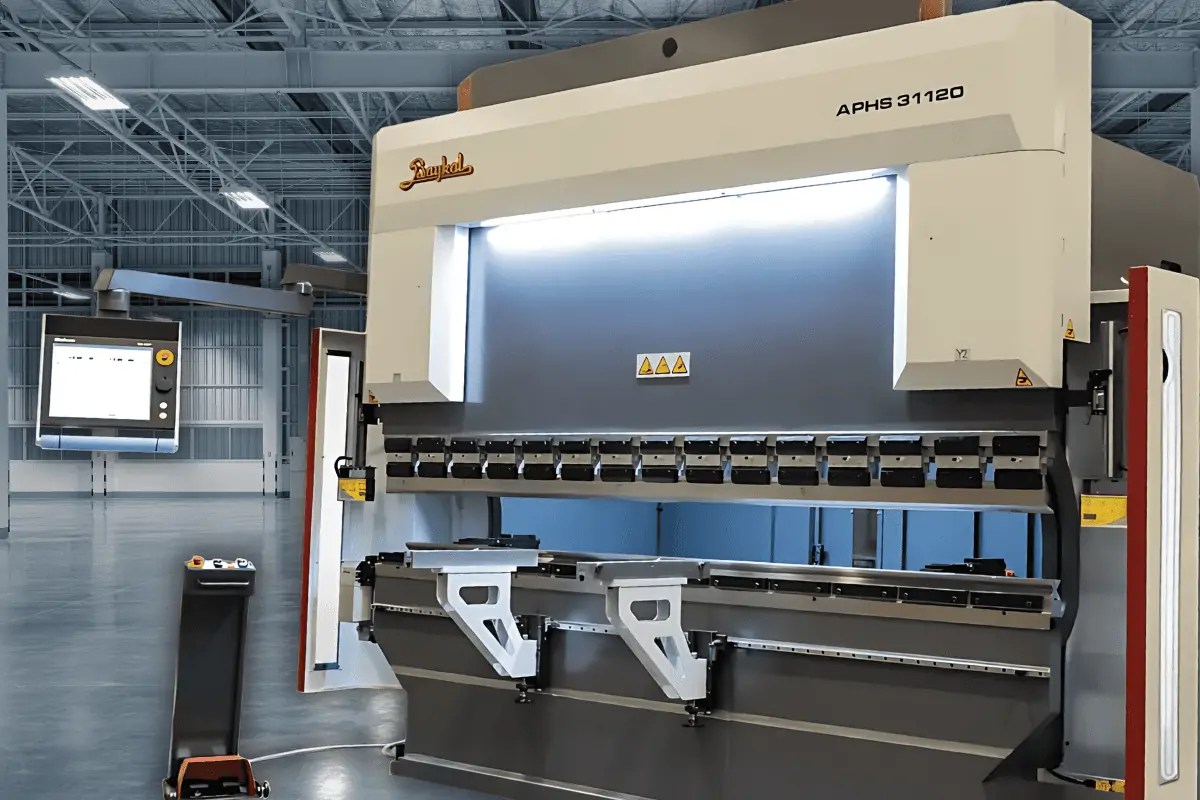
A manual press brake costs less to buy but a CNC press brake earns that difference back in setup time, repeatability and scrap reduction, usually within the first one to two years for a shop running more than a handful of different parts. The right choice depends on how many part programs you run, how often your bends change, and how much your operator’s time is worth.
We get this question from small fabrication shops constantly, usually right after a manual brake operator retires or a new job requires tighter tolerances than a hand-cranked back gauge can hold. Below is the honest breakdown: what each machine actually does well, what it costs to own over time, and how to decide without guessing.
What Is the Real Difference Between CNC and Manual Press Brakes?
A manual press brake relies on an operator to set the back gauge, ram stroke and bend angle by hand for every part, checking each bend with a protractor or by eye. A CNC press brake stores those settings as a program: back gauge position, ram stroke, tonnage and bend sequence are all recalled with a button press, and the machine repeats the same bend within a few thousandths every time.
The mechanical bending principle is identical on both. What changes is repeatability, changeover speed and how much of the process depends on one person’s skill and attention that day.
How Much Does Each Option Cost?
Manual press brakes for a small shop typically run from the mid five figures for a basic hydraulic unit, while a CNC hydraulic press brake in a comparable tonnage range starts higher and climbs with axis count and bed length. The gap narrows once you account for what a manual brake costs in labor and scrap over its life.
| Factor | Manual Press Brake | CNC Press Brake |
|---|---|---|
| Typical upfront cost | Lower | Moderate to higher, scales with axes and controller |
| Setup time per job change | 15 to 45 minutes, operator dependent | Under 5 minutes once a program exists |
| Repeatability part to part | Varies with operator skill and fatigue | Consistent within a few thousandths of an inch |
| Best fit | Low part variety, high volume of the same bend | Frequent job changes, mixed part runs, tighter tolerance work |
| Skill dependency | High. Output tracks operator experience | Lower once programmed. New operators ramp faster |
| Scrap risk on setup | Higher, especially on first-off parts | Lower, program recalls proven settings |
When a Manual Press Brake Still Makes Sense
If your shop runs the same two or three bends on the same gauge steel week after week, a manual brake is a legitimate, lower-cost tool. An experienced operator on a stable job can hold tolerance all day without a controller, and there is no software or programming overhead to manage. Shops with tight capital budgets and simple, repetitive work should not feel pressured into a CNC purchase they will not use to its potential.
When a CNC Press Brake Pays for Itself
The math flips once a shop runs mixed jobs, short production runs, or work that requires holding an angle within a degree across a batch. Every job change on a manual brake costs setup time and a first-part scrap risk; on a CNC brake that same change is a program recall. Shops that quote custom or one-off fabrication work, or that run multiple customers’ parts through the same brake in a day, typically see the CNC premium recovered in reduced labor and scrap inside 12 to 24 months.
Bed length, tonnage and axis count all affect price and capability more than the CNC label itself. A 6-axis backgauge system with tooling changes automated will cost more than a basic 2-axis CNC retrofit, and the extra axes only pay off if your part mix actually uses them.
What to Check Before You Buy Either Type
- Tonnage and bed length against your heaviest and longest real parts, not your average part
- Back gauge type and axis count if you are buying CNC, since this drives both price and changeover speed
- Available floor power and hydraulic service history if you are buying used
- Tooling compatibility, since new tooling for an unfamiliar brand adds real cost on top of the machine
- Local service and parts support for the brand you are considering, since downtime on a press brake stops a whole job queue
Our team has spent years helping small and mid-size fabrication shops size press brakes correctly the first time, and the most common mistake we see is buying tonnage and bed length for today’s job instead of the next three years of work.
A Simple Way to Run the Numbers Yourself
Before deciding, estimate three things for your own shop: how many job changes you run per week, how long each changeover takes on your current setup, and what your shop rate is per hour. Multiply changeover time saved per switch by the number of switches per week, then by your shop rate, and you get a rough weekly labor savings figure for CNC over manual. A shop running 15 job changes a week at 30 minutes saved per change and a $75 hourly shop rate is looking at roughly $560 a week, or close to $29,000 a year, well before counting reduced scrap on first-off parts. That number is what closes the price gap between the two machine types for most job shops.
Scrap reduction is the other side of the ledger and it is harder to estimate but often larger. A manual brake’s first part on a new setup is the highest-risk part in the run, since the operator is dialing in the bend by feel. A CNC brake recalls a proven program and its first part is typically as accurate as its hundredth. For shops running expensive material or tight-tolerance work, that alone can justify the CNC premium independent of labor savings.
Financing and New Versus Used Considerations
Both manual and CNC press brakes are commonly financed through equipment leasing or Section 179 depreciation, which changes the effective monthly cost comparison significantly versus a straight cash purchase. A used CNC press brake with verified service history and a working controller can also close much of the price gap with a new manual unit, giving a shop CNC flexibility without the full new-machine price tag. Whichever route you take, get the machine’s hydraulic and electrical systems inspected before purchase, since repair costs on a neglected used brake can erase any savings from the lower sticker price.
Frequently Asked Questions
Can a manual press brake be upgraded to CNC later?
Some manual hydraulic press brakes can be retrofitted with a CNC back gauge and controller, but retrofit quality and cost vary widely by machine age and frame condition. In most cases, buying a purpose-built CNC unit outright costs less over its life than retrofitting an older manual frame.
Do I need a CNC press brake if I only run a few jobs a week?
Not necessarily. If those jobs use the same bend program repeatedly, a manual brake with an experienced operator can be the more cost-effective choice. CNC earns its premium back through frequent changeovers, not idle capacity.
What tonnage press brake does a small shop typically need?
Most small job shops fall in the 40 to 175 ton range depending on material gauge and bed length, though heavier structural work pushes well beyond that. See our press brake tonnage sizing guide for how to calculate your specific requirement.
Is a used CNC press brake a reasonable alternative to a new manual brake at the same price?
Often, yes, if the hydraulics and controller have been inspected and the seller can show service history. A well-maintained used CNC brake can outperform a new manual unit on flexibility for a similar budget.
If you are weighing a CNC or manual press brake for your shop, our applications team can size the right tonnage and bed length for your actual part mix, not a generic recommendation. Get in touch with Fab-Line Machinery or call (888) 317-3615 for a free sizing consultation.