
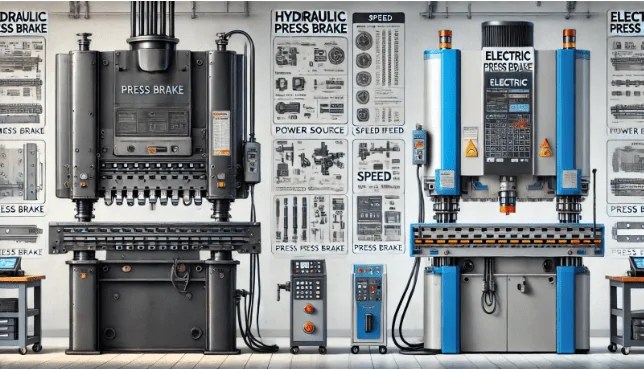
Press brakes are crucial instruments for precise bending in the field of metal manufacturing. Manufacturers have to weigh performance, cost, efficiency, and application compatibility when deciding between an electric press brake and a hydraulic press brake.
Overview of Press Brakes:
Press brakes are devices that bend metal sheets into the forms that are wanted. Steel manufacturing, HVAC, construction, automotive, and aerospace are just a few of the sectors that employ them extensively. When it comes to technology, operation, and efficiency, the two main types of press brakes, electric and hydraulic, each have unique benefits and limitations.
Hydraulic Press Brakes:
1. How They Work:
Hydraulic press brakes bend metal by applying force through hydraulic cylinders. Hydraulic fluid, which is managed by pumps and valves, produces the pressure.
2. Advantages:
- Durability & Reliability: Proven technology with decades of industry use
- High Tonnage Capability: Ideal for bending thick and heavy metal.
- Cost-Effective for Large-Scale Operations: Less expensive initially than electric press brakes.
- Better for Deep and Complex Bends: Effectively manages larger workloads.
3. Disadvantages
- Slower Operation: Cycle durations are greater than with electric versions
- Higher Maintenance Needed: Constant operation of hydraulic systems results in higher energy expenses. Regular replenishment of hydraulic fluid is necessary, and leaks can result in downtime.
Electric Press Brakes
1. How They Work
Servo motors are used by electric press brakes, sometimes referred to as servo-driven press brakes, to produce force for bending operations. They use less energy since they don’t depend on fluid pressure as hydraulic versions do.
2. Advantages:
- Accuracy & Precision: Provides more control over consistent bending angles.
- Energy Efficiency: Compared to hydraulic devices, it uses up to 50% less energy.
- Faster Cycle Times: Shorter lead times due to increased manufacturing speed.
- Lower Maintenance Costs: Less maintenance and fewer failures result from the absence of hydraulic fluid.
- Eco-friendly: There is no chance of contamination or fluid leakage.
3. Disadvantages:
- Greater Initial Investment: Usually more costly than devices that use hydraulics.
- Limited Tonnage Capability: For very thick metal sheets, the limited tonnage capability is not the best option.
- Less Fit for Heavy-Duty Bending: Ideal for lightweight, precision-based applications.
Performance Comparison: Hydraulic vs. Electric Press Brake
| Feature | Hydraulic Press Brake | Electric Press Brake |
| Power Source | Hydraulic cylinders | Servo motors |
| Energy Efficiency | High energy consumption | Up to 50% energy savings |
| Speed | Slower cycle times | Faster operation |
| Precision | Moderate accuracy | High precision & repeatability |
| Maintenance | Requires regular upkeep | Minimal maintenance |
| Cost | Lower upfront cost | Higher initial investment |
| Best For | Heavy-duty applications | Precision & high-speed production |
Which One to Choose?
Go for a Hydraulic Press Brake if:
- You deal with bigger and thicker metal sheets.
- For heavy-duty bending, you need an affordable solution.
- Your manufacturing pace is not the most important factor.
- You have a hydraulic systems maintenance schedule in place.
Opt for an Electric Press Brake if:
- Complex bending calls for a high level of accuracy and precision.
- Faster manufacturing rates and energy efficiency are crucial.
- Low maintenance costs and environmental sustainability are top priorities for your store.
- Instead of working with heavy-duty metals, you work with light to medium gauge materials.
Future of Press Brakes:
More automation, sustainability, and efficiency are the new trends in metal manufacturing. Hybrid press brakes are also becoming more and more popular since they combine the accuracy of electric machines with the strength of hydraulic ones. Electric press brakes have the potential to become the industry standard for several applications as AI-driven automation and IoT-connected machines continue to advance.
Conclusion:
Depending on your unique fabrication requirements, you can choose between an electric and hydraulic press brake. Electric press brakes provide accuracy, speed, and energy savings, whereas hydraulic press brakes are best suited for heavy-duty applications. Purchasing the appropriate equipment helps increase productivity, lower expenses, and streamline your metalworking business.
Do you want professional advice on how to choose the finest press brake for your company? For solutions that are specifically suited to your manufacturing requirements, get in touch with Fab-Line Machinery right now!