

A press brake can only bend as accurately as it can position the material, and that job belongs to the backgauge. If you have ever watched a part come off a brake with a flange a few thousandths out of spec, the cause is rarely the ram or the tooling. It is usually the backgauge, either because it was never set up correctly or because the shop is running an older unit that cannot hold position under load.
Fab-Line Machinery is the exclusive U.S. importer of Baykal press brakes, and every APHS and APHS-C model we sell ships with a CNC-controlled backgauge system. This article covers what a backgauge actually does, the difference between a basic X-axis unit and a multi-axis system, and how to tell whether the backgauge on your shop floor is still earning its keep. Our technical team fields this question constantly from shops evaluating a new brake against retrofitting an existing one, drawing on years of experience speccing Baykal machines for job shops and production fabricators across the country.
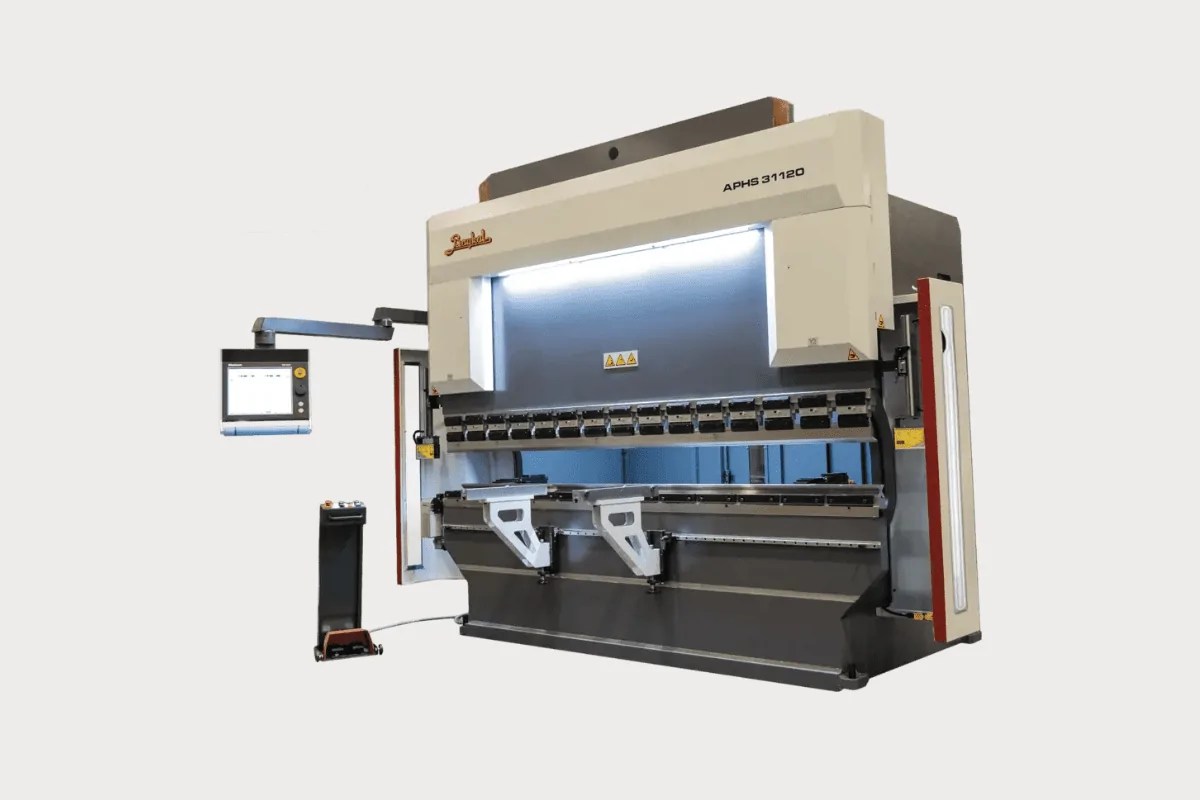
What does a press brake backgauge do?
The backgauge is the positioning system at the rear of the press brake that stops the sheet at the exact depth needed for the bend. The operator, or the CNC control on an automated brake, moves the backgauge fingers to a programmed distance from the die centerline, slides the sheet metal back until it contacts the fingers, and the machine bends at that point every time. Get the backgauge position wrong by even a small amount and every flange, every hole pattern, and every mating part downstream is off.
On a manual brake, this is a hand crank and a ruler. On a Baykal APHS or APHS-C, it is a servo-driven axis controlled by the CNC, repeatable to within a few thousandths of an inch, run after run, shift after shift.
X-axis versus multi-axis backgauge systems
A basic backgauge moves on a single axis, X, which is depth, toward or away from the ram. That is enough for simple parts with one bend or a run of identical bends on flat stock. It is not enough once a job calls for parts with multiple bend sequences, tapered flanges, or finger positions that need to shift sideways between bends.
A multi-axis backgauge adds:
- Z-axis (left/right): each backgauge finger moves independently along the width of the machine, so a single setup can handle parts where one edge needs a different stop position than the other.
- R-axis (height): the backgauge fingers raise and lower to clear a part that has already been bent once, which matters on box and pan parts where the first bend would otherwise collide with the gauge on the second or third hit.
- X1/X2 independent positioning: on wider brakes, splitting the X-axis in two lets the gauge support tapered or angled parts where the left and right stop points are not the same distance from the blade.
The APHS-C line is built for shops running mixed, lower-volume jobs where backgauge flexibility saves more time in changeover than raw tonnage ever will. If your shop is still quoting jobs around a single-axis gauge, a multi-axis retrofit or a newer machine usually pays for itself in reduced setup time alone, before counting the scrap avoided from bad first pieces.
| Backgauge type | Axes | Best fit |
|---|---|---|
| Basic (manual) | Hand-set, no CNC | Low-volume, single-bend parts, job shops without repeat work |
| 2-axis CNC (X, R) | Depth and height | Repeat production runs with a consistent bend sequence |
| Multi-axis CNC (X1/X2, Z, R) | Independent left/right positioning plus depth and height | Mixed job shops, tapered flanges, box and pan parts with multiple bend stages |
A shop that cuts sheet metal and shears blanks before bending them should also weigh how backgauge accuracy on the brake interacts with upstream tolerance from the hydraulic shear cutting the blanks in the first place. A backgauge cannot correct for a part that was already out of square coming off the shear.
How backgauge accuracy affects part quality
Bend-to-bend repeatability is the entire value of a CNC backgauge. A part with four bends and four stop positions multiplies any gauge error by four. On stainless or aluminum parts bound for a weldment or an enclosure, a backgauge that drifts even 0.005 inches over a production run is the difference between parts that assemble clean and parts that need rework at the welding station.
Three things degrade backgauge accuracy over time on any brake, Baykal or otherwise:
- Ball screw wear. The backgauge axis rides on a ball screw and linear guides. Years of heavy sheet stock sliding into the fingers wear the screw and introduce backlash, a small amount of play before the axis actually moves when commanded.
- Finger alignment. If the backgauge fingers are not square to the bed, the sheet contacts one finger before the other, and the part comes off the brake with a bend line that is not parallel to the edge.
- Calibration drift. Like any CNC axis, the backgauge needs periodic calibration against a known reference. A brake that has not been recalibrated in a year or more is a common, overlooked source of parts that are “close enough” until a tighter-tolerance job exposes the problem.
We cover the daily and monthly side of this in our guide to press brake calibration, which is worth running through before assuming a backgauge needs replacement rather than adjustment.
Retrofitting an older press brake versus buying new
A shop running an older manual or single-axis brake does not always need to replace the entire machine to get CNC backgauge control. Backgauge retrofit kits exist and can bring an older frame up to a basic 2-axis CNC system. Where this makes sense:
- The press, ram, and tooling are mechanically sound and the frame has years of service life left.
- The shop’s part mix is simple enough that a 2-axis retrofit, not a full multi-axis system, covers the work.
- Budget favors extending the life of existing equipment over a full capital purchase this year.
Where a retrofit stops making sense is tonnage. A backgauge upgrade does not change what the ram and frame can physically bend. If the shop is quoting jobs it has to turn down because the existing brake tops out below the tonnage or bed length the work needs, that is a press brake purchase decision, not a backgauge decision. Our press brake tonnage guide walks through sizing a new machine against your actual part mix.
Frequently asked questions
How accurate is a CNC press brake backgauge?
A well-maintained CNC backgauge on a Baykal APHS or APHS-C holds repeatability within a few thousandths of an inch, run after run. Accuracy degrades over time from ball screw wear, finger misalignment, or missed calibration, which is why a backgauge that was accurate when installed can still drift years later without any change to the machine’s programming.
What is the difference between a 2-axis and multi-axis backgauge?
A 2-axis backgauge controls depth (X) and height (R), enough for straightforward parts with a single bend sequence. A multi-axis backgauge adds independent left and right finger positioning (Z, X1/X2), which is what lets one setup handle tapered flanges, box parts, and jobs where the two edges of the sheet need different stop points.
Can an older press brake be upgraded with a CNC backgauge?
Yes, in many cases a backgauge retrofit kit can add CNC-controlled positioning to an older manual or single-axis brake, provided the press frame, ram, and tooling are still in good mechanical condition. A retrofit does not add tonnage or bed length, so it only solves accuracy and repeatability, not capacity.
How often should a press brake backgauge be calibrated?
Most shops running daily production should check backgauge calibration at least quarterly, and immediately after any crash, tooling change, or part quality complaint tied to bend location. Heavier-use shops running multiple shifts often calibrate monthly to catch ball screw wear before it shows up as scrap.
Talk to Fab-Line about backgauge options
Whether you are speccing a new Baykal APHS press brake with a multi-axis backgauge or trying to decide if your current machine is worth retrofitting, our team can walk through your part mix and tell you plainly which option gets you the accuracy you need. Contact Fab-Line Machinery or call 888-317-3615 to talk through your shop’s setup.