
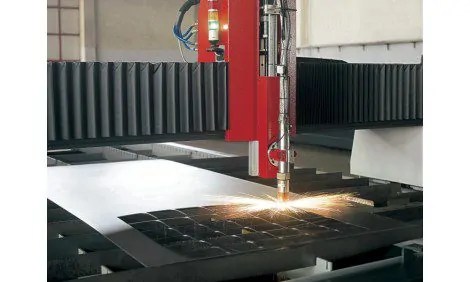

Plasma cutting consumables wear out on a schedule set by amperage, duty cycle and material, not by a calendar, and most shops replace them either too early (wasting money) or too late (wasting metal and time on bad cuts). A worn tip or electrode shows up first as a rougher edge, more dross, and a wider kerf, and catching that early is what keeps cost per part predictable.
What Wears Out First on a Plasma Torch
The electrode and nozzle (tip) wear together and almost always fail before the swirl ring, retaining cap or shield. The electrode has a hafnium insert that erodes with every pilot arc start and every cut; the nozzle orifice enlarges as the arc erodes its edges. Once the orifice grows past its rated size, the arc loses focus and the cut quality drops even though the torch still fires normally.
How Often Should You Replace Plasma Consumables?
As a starting point for a shop running mild steel at 40 to 100 amps: check the nozzle and electrode every 4 to 6 hours of arc-on time, not shop hours. High-amperage cutting (over 100A) or heavy pierce work shortens that to 2 to 4 hours. Thin-gauge sheet metal at low amperage can run 8 hours or more between checks. These are ranges, not guarantees; the cut itself is the real signal.
| Warning Sign | What It Means | Action |
|---|---|---|
| Rounded or blunted electrode tip | Hafnium insert eroded past spec | Replace electrode now |
| Enlarged or oval nozzle orifice | Arc has lost focus, kerf widening | Replace nozzle, check electrode too |
| Excessive dross on the cut underside | Consumables worn or amperage mismatched | Inspect consumables before adjusting amperage |
| Double arcing (arc jumping inside the torch) | Nozzle orifice too worn to contain the arc | Stop cutting, replace nozzle immediately |
| Shorter pierce life than usual | Electrode near end of life | Replace electrode before next job |
What Drives the Real Cost of Consumables
Consumable cost per part is a function of pierces per set, not hours run. Every pilot arc start uses up electrode life, so a job with a lot of small pierced holes burns through consumables faster than a job with a few long straight cuts at the same amperage. Shops that batch small-hole work into dedicated runs, rather than mixing it with long cuts, get more life out of every set.
OEM consumables cost more per piece than aftermarket, but the difference in orifice tolerance and coating quality shows up directly in edge squareness and consistency, which matters most on parts headed to a welder or a paint line without secondary finishing. For parts that get ground or machined afterward, aftermarket consumables are a reasonable way to control cost.
A Simple Maintenance Routine That Extends Life
- Check torch height and standoff distance; running too close or too far accelerates wear on both ends.
- Keep amperage matched to material thickness. Overpowering thin material burns consumables faster for no cut quality benefit.
- Inspect the swirl ring and shield at every consumable change, not just when they visibly fail.
- Store spare consumables in a sealed case. Humidity and shop dust degrade unused parts sitting in an open bin.
Our service team at Fab-Line walks shops through this exact inspection routine on Baykal plasma systems, and the most common finding is amperage set higher than the material calls for, which shortens consumable life without improving the cut. Fab-Line’s service technicians have over 15 years of experience combined setting up and servicing Baykal plasma systems for job shops across the country.
Frequently Asked Questions
How do I know if my plasma cutter needs new consumables or if the problem is something else?
Check consumables first. A rough cut, excess dross, or an arc that will not stay lit is worn electrode or nozzle in the large majority of cases. If new consumables do not fix it, check gas pressure and torch height before assuming a machine fault.
Can I mix brands of plasma consumables?
Only if the manufacturer explicitly rates cross-compatibility. Mismatched orifice tolerances between brands is a common, avoidable cause of inconsistent cuts.
Does higher amperage always mean faster consumable wear?
Generally yes, but the bigger factor is pierce count. A high-amperage machine cutting thick plate with few pierces can outlast a lower-amperage machine doing repetitive small-hole work.
If your shop is chasing inconsistent cut quality or higher-than-expected consumable spend, a plasma cutting system paired with the right consumable program and duty cycle can bring cost per part back under control. Our team also services and sets up press brakes and hydraulic shears for the same shops. Contact Fab-Line or call (888) 317-3615 to talk through your current setup.
Building a Consumable Inventory That Does Not Slow Down Production
The most common downtime story in a fabrication shop is not a broken machine, it is a torch sitting idle because nobody has a spare electrode on the shelf. A basic rule of thumb: keep at least one full spare set (electrode, nozzle, swirl ring, shield) per amperage range your shop runs regularly, and reorder when you break into your second-to-last set, not your last one. Shops running two or three amperage ranges across different jobs should keep sets for each range labeled separately, since a 45A nozzle mounted on a 100A job (or the reverse) is a fast way to burn through consumables and get a bad cut at the same time.
Tracking consumable spend by job, even roughly, tells you more than tracking it by month. A shop that notices one recurring job is eating consumables twice as fast as everything else usually finds the amperage is set wrong for that specific material thickness, or the operator is running a faster travel speed than the torch height supports.
When Consumable Wear Signals a Bigger Problem
If a fresh set of consumables still produces a rough cut, dross, or arc instability within the first hour of use, the issue usually is not the consumables. Check air or nitrogen supply pressure and moisture content first (a wet air line degrades cut quality and consumable life together), then check torch lead condition and ground clamp connection. Consumables that wear unevenly around the orifice, rather than uniformly, often point to a torch that is not being held perpendicular to the material, which is an operator technique issue more than a parts issue.
What is the difference between a nozzle and an electrode on a plasma torch?
The electrode sits behind the nozzle and carries the pilot arc; it has the hafnium insert that erodes with use. The nozzle, sometimes called the tip, focuses and shapes the arc as it exits the torch. Both wear on a similar timeline and most shops replace them together rather than waiting for one to fail first.
Is it worth buying a plasma cutter with automatic consumable life monitoring?
For high-volume shops running multiple shifts, yes: it removes the guesswork and prevents both premature replacement and running consumables past failure. For a lower-volume shop, a simple hour-and-pierce-count log tracked by the operator accomplishes the same thing at no added machine cost.